The Pallet Density Dilemma
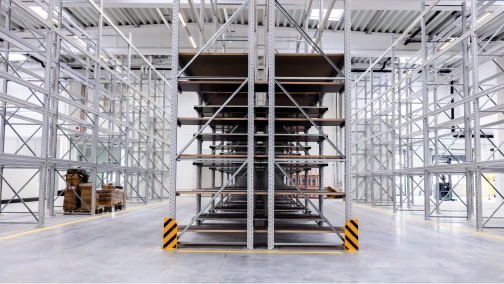
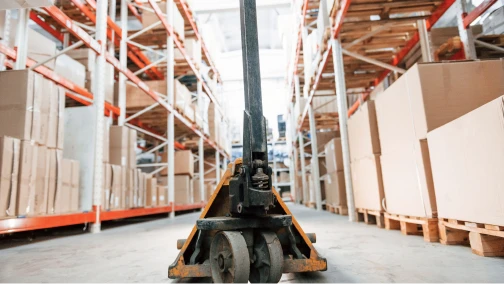
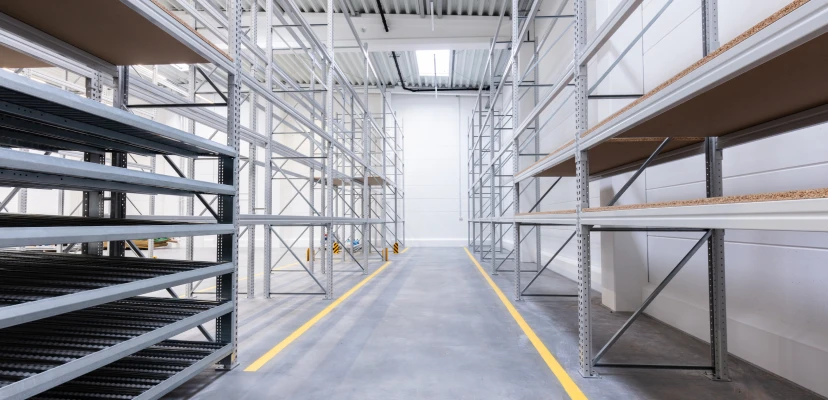
Conventional selective pallet racking solves access and sacrifices space. Every rack row needs a fixed forklift aisle of three meters or more, so in a typical layout over half the floor area is aisle rather than storage. When a facility runs out of room, the first instinct is to build or lease more space, but two established technologies can usually recover the missing capacity inside the existing walls: mobile pallet racking and unit-load AS/RS.
Both systems attack the same waste, the fixed aisle, but from opposite directions. Mobile racking keeps the forklift and removes the aisles by moving the racks themselves. Unit-load AS/RS removes the forklift entirely and lets a crane work in aisles barely wider than the pallet. The choice between them shapes capital cost, throughput, labor structure, and even refrigeration bills for years, which makes it worth examining with real numbers rather than catalog claims.
This comparison covers working principles, density and height limits, throughput behavior, cold storage performance, and cost structure, followed by the decision criteria we apply when engineering pallet storage projects.
How Each System Works
Mobile Pallet Racking: Moving the Rack to the Aisle
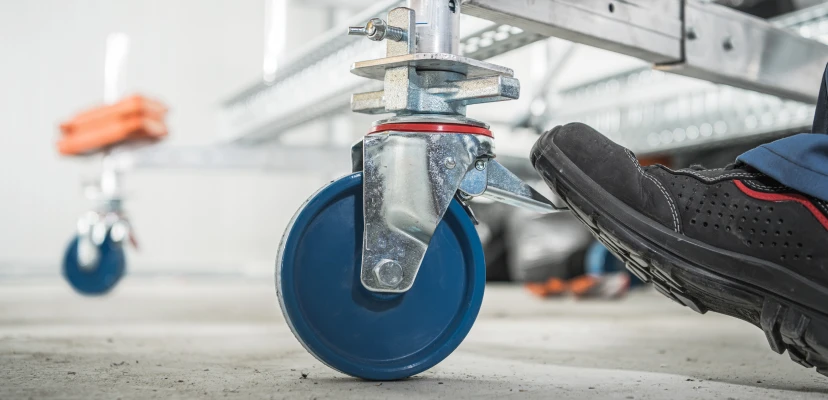
Mobile pallet racking mounts conventional rack rows on motorized carriages that travel on rails embedded in the floor. All rows sit packed together as a solid block; when a forklift needs access, the operator opens a single working aisle at the required position by remote control or push button. Carriages can run to 50 meters or more in length and carry fully loaded racks, and safety light barriers, proximity sensors, and soft start-stop drives protect anyone inside the block while rows are in motion. The defining feature is that density nearly doubles while selectivity stays at 100 percent: every pallet remains individually reachable, exactly as in selective racking.
Unit-Load AS/RS: Moving the Pallet by Crane
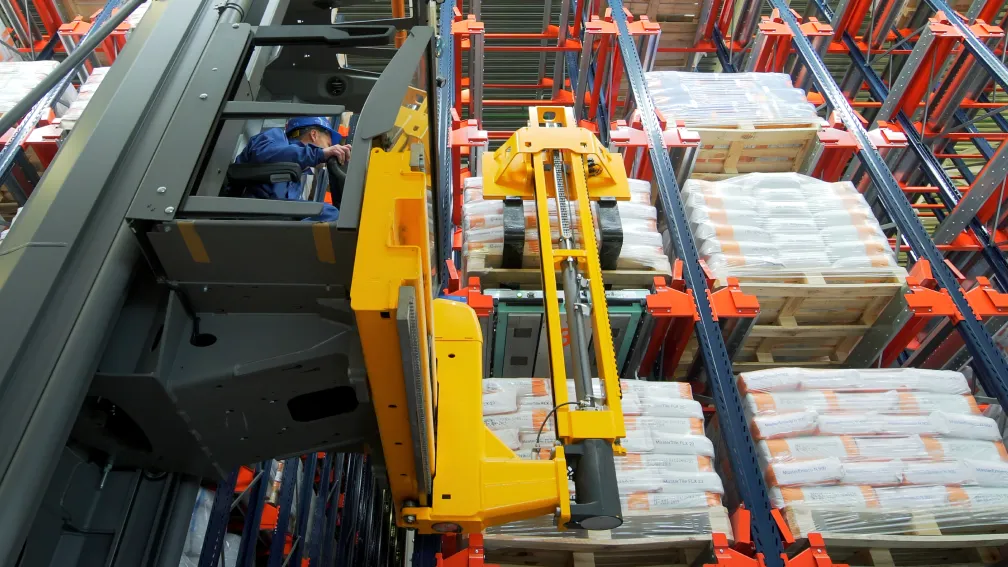
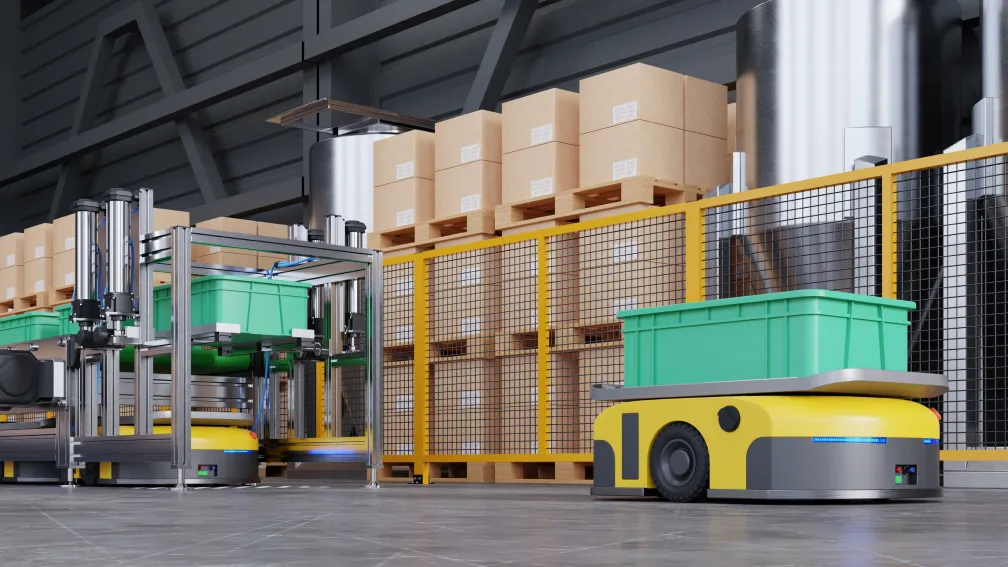
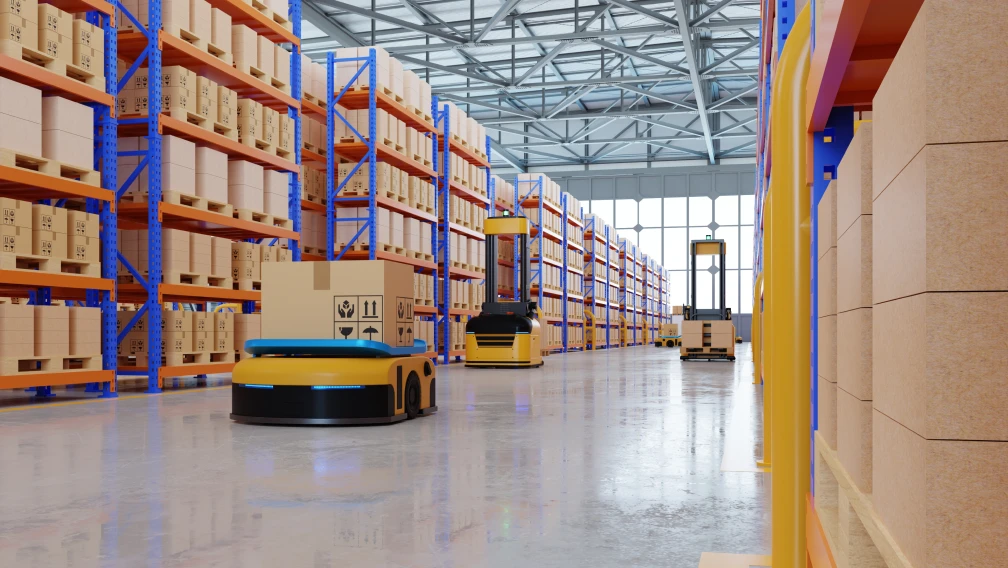
A unit-load AS/RS replaces the forklift aisle with a narrow crane aisle. An aisle-captive stacker crane travels between two rack faces, placing and retrieving pallets at heights up to roughly 40 meters under WMS command. Pallets arrive and leave through conveyor stations at the rack front, so no person or forklift enters the storage structure at all. Storage and retrieval become software-scheduled machine cycles rather than driving tasks, and inventory accuracy is set by the system rather than by operator discipline.
Density, Height, and Footprint Compared
The density math explains why mobile racking exists. Static selective racking converts roughly 30 to 40 percent of floor area into storage positions once aisles are counted. A mobile block needs only one aisle, which pushes storage density up by 80 to 90 percent over the same footprint and can double pallet capacity in an existing building. Unit-load AS/RS achieves comparable or better floor density, but its real advantage is vertical: where mobile racking tops out at about 7 to 8 meters because forklift reach sets the limit, an AS/RS high-bay climbs to 30 or 40 meters. In a tall building, the crane system stores several times more pallets per square meter of floor. In a low building, that advantage disappears entirely.
| Parameter | Mobile Pallet Racking | Unit-Load AS/RS |
|---|---|---|
| System type | Semi-automated, forklift-operated | Fully automated, crane-operated |
| Practical height limit | ~7–8 m (forklift reach) | Up to ~40 m (high-bay) |
| Density gain vs. static racking | +80–90% | Comparable floor density, far greater with height |
| Pallet selectivity | 100% | 100% (single-deep) or reduced (multi-deep) |
| Throughput profile | Low to medium; one open aisle at a time | High; continuous machine cycles, 24/7 capable |
| Labor model | Forklift operators inside the system | No personnel in storage structure |
| Typical cost per pallet position | Roughly $200–600 | Higher capital, offset by labor and height utilization |
| Best building fit | Existing, low-ceiling, rectangular spaces | New builds or tall facilities with strong floors |
Throughput and Labor: Where the Systems Diverge
The single working aisle is mobile racking's density engine and its throughput ceiling. Only one aisle can be open at a time, so two operators needing pallets from different rows must take turns, and every access begins with a carriage movement. In practice this caps the system at low-to-medium movement frequency, which is why mobile racking fits slow-to-medium movers, reserve stock, and seasonal inventory far better than fast-turning dispatch stock. Aisle opening takes seconds, but accumulated across hundreds of daily movements it becomes the constraint.
A unit-load AS/RS has no equivalent bottleneck. The crane runs continuous, software-sequenced cycles, dual commands where a storage and a retrieval combine into one trip, and throughput scales by adding aisles or cranes. The labor structures diverge just as sharply: mobile racking still needs trained forklift drivers working between moving steel rows, while AS/RS concentrates staff at ergonomic conveyor stations. For operations struggling to hire and retain warehouse drivers, that difference increasingly decides the business case on its own.
Cold Storage: A Special Case
Freezer and chilled warehouses reward density twice. Building volume in a cold store is expensive to construct and every cubic meter costs energy to refrigerate, so compacting pallets into a mobile block cuts both the building footprint and the air volume being cooled. Mobile racking has a long track record in frozen food storage for exactly this reason. The trade-off is human: forklift drivers still work inside the cold room, at temperatures that can reach -30°C, with the productivity losses and break schedules that implies.
An AS/RS inverts this arrangement. The cranes work in the cold zone while the conveyor stations where people handle pallets sit in a tempered area at 0 to 5°C. Staff never enter the deep cold, and machine cycles continue through shifts and weekends without fatigue. For high-throughput frozen distribution this labor arrangement often outweighs the capital difference; for low-movement frozen reserve storage, mobile racking's simpler economics usually win.
Cost Structure and Payback
Mobile racking carries a moderate capital premium over static racking, typically quoted around $200 to 600 per pallet position against $50 to 400 for static systems, with rails, carriages, and drives accounting for the difference. The payback comes from avoided building expansion: doubling capacity inside the existing walls is almost always cheaper than new construction, and in cold stores the refrigeration savings add a second return stream. Unit-load AS/RS requires substantially higher capital, but the return calculation includes labor reduction of 50 percent or more on storage and retrieval, near-total inventory accuracy, and the capacity multiplier from building height. The two systems also combine well: many facilities run AS/RS for fast movers and mobile racking for reserve and slow-moving pallets in the same building. For a structured approach to the investment math, see our guide on calculating AS/RS payback.
Safety and Maintenance Considerations
Mobile racking concentrates an entire storage block on moving machinery, so its safety engineering matters. Current-generation systems carry light barriers across every aisle entrance, pressure-sensitive edges on carriage frames, and automatic locking that prevents carriage movement while an operator is inside an open aisle. Maintenance centers on rails, drive motors, and control electronics, and stays closer to industrial door upkeep than to crane servicing. A unit-load AS/RS removes personnel from the storage structure entirely, which eliminates most collision exposure by design, but it introduces crane, conveyor, and software maintenance that requires trained technicians and planned downtime windows. Both systems need documented inspection schedules; the difference is whether the maintenance skill set lives with a local racking service or with an automation integrator.
Decision Criteria: Which System Fits Your Operation
Working through pallet storage projects, the selection usually settles on five questions:
1. Building height. Below roughly 8 meters of usable clear height, AS/RS loses its vertical advantage and mobile racking's density gain dominates the comparison. Above 12 meters, the crane system starts pulling ahead on capacity per square meter.
2. Movement frequency. Under a few dozen pallet movements per hour with tolerance for sequential aisle access, mobile racking performs well. Sustained high-frequency dispatch operation points to AS/RS.
3. Labor availability. Where forklift drivers are available and affordable, mobile racking's operating model is sustainable. Where labor is scarce, expensive, or working in deep cold, removing drivers from the storage zone changes the equation.
4. Inventory profile. Mobile racking suits homogeneous, slow-to-medium moving stock with full selectivity requirements. Mixed velocity profiles with a fast-moving dispatch core favor automation, often in a hybrid layout.
5. Software ambition. An AS/RS runs on WMS-directed tasks with a complete digital record of every movement, which our warehouse control system provides along with ERP integration. Mobile racking can connect to a WMS for location management but remains operator-executed.
If you are weighing these options for a new facility or a capacity upgrade, our engineering team can model both configurations against your pallet profile, building dimensions, and movement data and return a comparison with projected payback. Contact us to start the assessment.
-

HOWEPROFIT Team
Warehouse Automation Specialists, HOWEPROFIT
The HOWEPROFIT Team consists of senior intralogistics engineers and supply chain experts specializing in advanced AS/RS and robotic fulfillment solutions. Backed by years of field experience across e-commerce, 3PL, and manufacturing sectors, we provide data-driven automation strategies, rigorous throughput simulations, and objective ROI modeling. Our mission is to help facilities seamlessly transition to high-efficiency, reliable, and scalable automated operations.