The One Difference That Matters
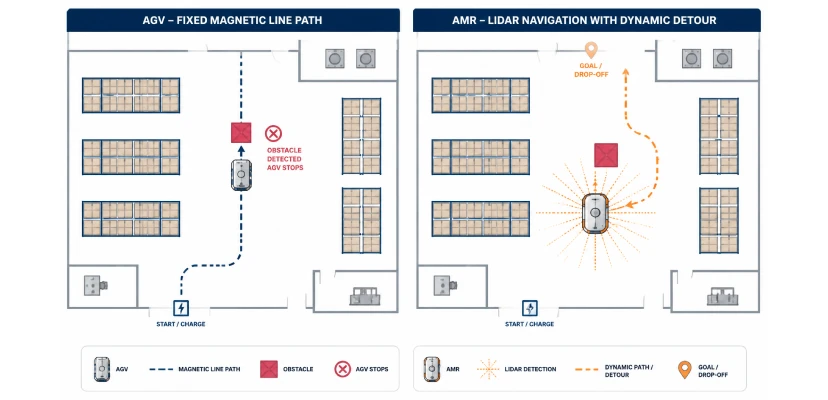
Ask three vendors to explain AGV versus AMR and you will get three marketing answers. The engineering answer is shorter: navigation. An automated guided vehicle follows a path someone fixed in advance, using magnetic tape, wires, QR codes, or reflectors installed in the facility. An autonomous mobile robot builds its own path from onboard sensors and a map, using SLAM and lidar to see the building as it is, not as it was drawn. That single difference cascades into everything else buyers care about: infrastructure cost, deployment time, obstacle behavior, and how painful a layout change will be two years from now.
This article compares the two technologies on the dimensions that decide real projects, with current cost figures and the safety standards that apply to both.
How Each Technology Navigates
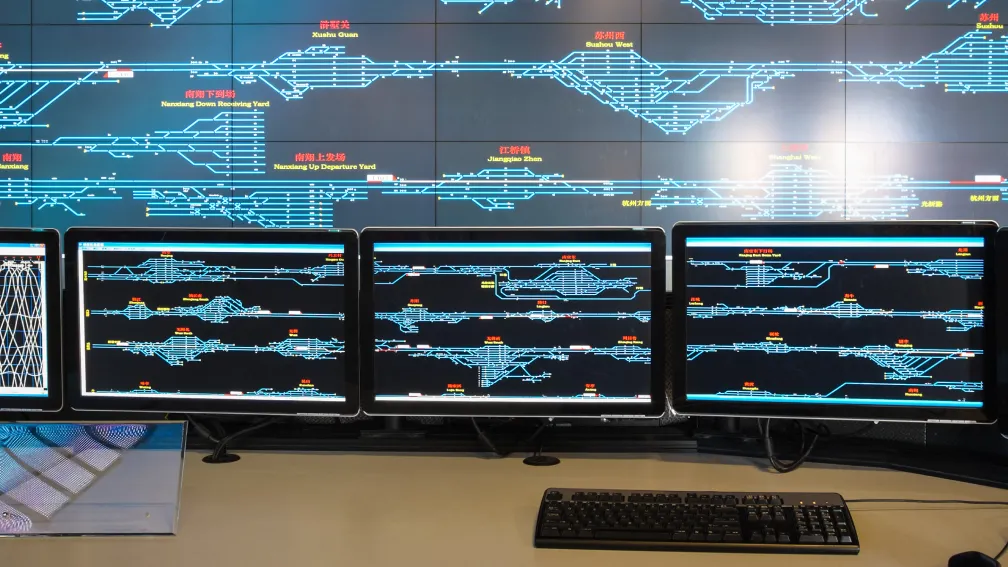
An AGV's guidance lives in the building. Magnetic tape or wire embedded in the floor, painted lines, QR code grids, or laser reflectors mounted on walls and columns define where the vehicle can go. The vehicle follows that guidance with high repeatability, which is exactly why production lines trust it. The cost is that the route is a construction project: changing it means physical work, and an obstacle in the path stops the vehicle until someone clears it.
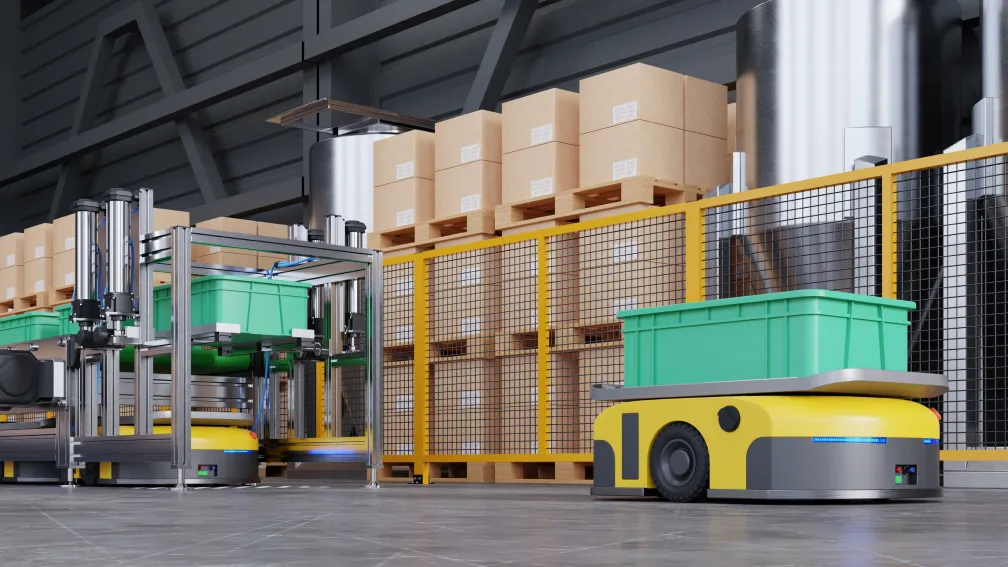
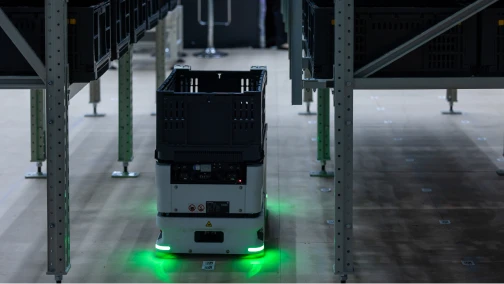
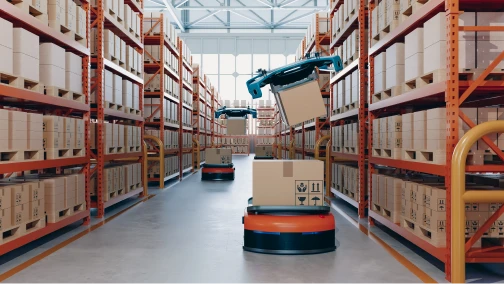
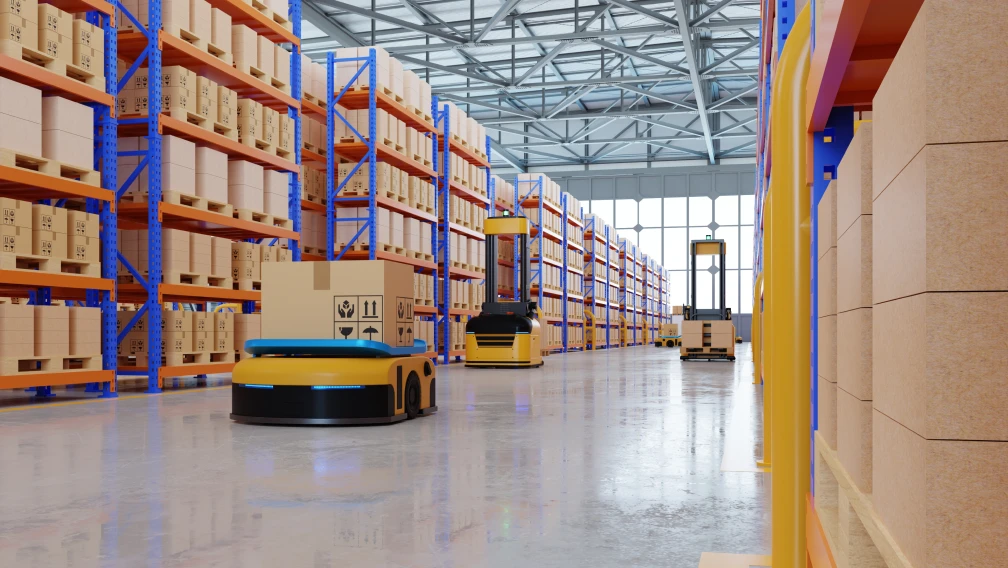
An AMR's guidance lives in the vehicle. The robot maps the facility with lidar and cameras, localizes itself against natural features like walls and racking, and plans its own route to each destination. When a pallet or a person blocks the way, it slows, stops, or calculates a detour and continues. Nothing physical is installed in the floor, so deployment is a mapping exercise and reconfiguration is a software edit. The trade-off is that the robot depends on a consistent environment: a warehouse that rearranges its racking weekly will need remapping, and dusty or highly reflective environments stress the sensors.
The Practical Differences, Side by Side
| Dimension | AGV | AMR |
|---|---|---|
| Navigation | Fixed guidance: tape, wire, QR grid, reflectors | SLAM and lidar against natural features |
| Blocked path | Stops and waits for clearance | Reroutes around the obstacle |
| Infrastructure | Physical guidance installed in the facility | Mapping only; minimal facility changes |
| Typical payload | Engineered for heavy loads, up to multi-ton assemblies | Commonly up to about 1 ton; heavy-duty models exist |
| Precision | Exact, repeatable docking for production work | Accurate, but dynamic paths trade some repeatability |
| Reconfiguration | Physical rework of guidance | Software remap, often same-day |
| Maintenance skill set | Traditional PLC and controls background | PC-based software and sensor calibration |
| Best fit | Stable, high-volume, repetitive routes | Changing layouts, mixed traffic, flexible workflows |
Where AGV Still Wins
Guided vehicles hold a durable niche, and it is not a legacy niche. When the same load travels the same path thousands of times, predictability is the requirement. Heavy assembly lines moving multi-ton products on a fixed takt, deterministic pallet transfer between production and staging, and any application needing exact repeat docking are AGV territory. The maintenance argument matters too: AGV upkeep draws on the PLC and controls skills most plant maintenance teams already have, while AMR fleets lean on scarcer software and IT skills. Reports of the AGV's death are marketing. The technology is evolving, adding vision and lidar options, not being retired.
Where AMR Wins
AMRs earn their premium wherever change is normal: layouts that shift seasonally, delivery points that vary with product mix, floors shared with people and forklifts, and workflows like line-side replenishment, zone-to-zone transport, and dock-to-stock. The obstacle behavior alone changes operations in busy facilities. A stopped AGV blocks a route; a blocked AMR finds another one. For brownfield sites that cannot tolerate floor work or downtime during installation, map-and-go deployment is often the deciding factor.
Cost: Compare Systems, Not Stickers
Current market figures put a standard AMR at roughly $25,000 to $150,000 per unit, and a catalog AGV at $15,000 to $75,000 per vehicle, before infrastructure and integration. That comparison misleads on its own. AGV infrastructure on a larger site commonly adds $50,000 to $200,000, and integration, network upgrades, and support typically add 40 to 60 percent on top of hardware list prices for either technology. A realistic first-year pilot of three to five vehicles, including integration and training, lands between $100,000 and $500,000. Robot-as-a-service subscriptions, roughly $2,000 to $8,000 per robot per month, shift the same capability into operating expense. The cheapest vehicle rarely produces the lowest total cost; count infrastructure, reconfiguration work, and downtime before comparing quotes.
Safety Standards Apply to Both
Neither technology is inherently safer; safety comes from the standard and the risk assessment, not the badge. Internationally, ISO 3691-4:2023 covers driverless industrial trucks of both types, requiring PLd-rated personnel detection, redundant safety controllers, and verified stopping performance. In North America, ANSI/RIA R15.08 addresses industrial mobile robots in three parts covering the robot, the integrated system, and the end user's site obligations, while ANSI B56.5 remains relevant for path-following AGVs and automated forklifts. One point that surprises buyers: the vehicle's certification does not certify your site. System-level safety is the integrator's and operator's responsibility, documented through a site-specific risk assessment.
How to Decide
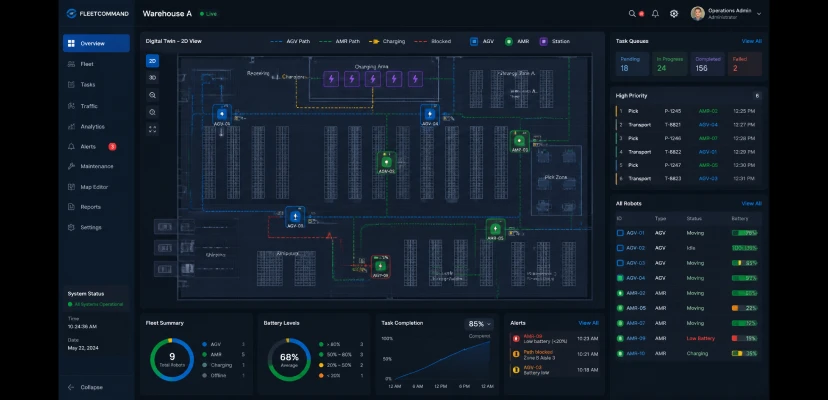
The honest decision process starts with data, not demos. Collect travel paths, order profiles, peak-hour volumes, payload requirements, floor condition, aisle widths, and how often your layout has actually changed in the past three years. If routes are stable and loads are heavy, price an AGV solution first. If routes change, traffic is mixed, or downtime for floor work is unacceptable, price an AMR fleet. And do not assume it is either-or: industry data shows 42 percent of new warehouse automation projects now combine fixed and mobile automation, up from 28 percent in 2022, and mixed AGV-AMR fleets coordinated under one fleet management layer are increasingly common.
If you are evaluating mobile robots for a warehouse or production facility, our engineering team can model your routes and payload profile against both architectures and return a costed comparison. Contact us to start the assessment.
-

HOWEPROFIT Team
Warehouse Automation Specialists, HOWEPROFIT
The HOWEPROFIT Team consists of senior intralogistics engineers and supply chain experts specializing in advanced AS/RS and robotic fulfillment solutions. Backed by years of field experience across e-commerce, 3PL, and manufacturing sectors, we provide data-driven automation strategies, rigorous throughput simulations, and objective ROI modeling. Our mission is to help facilities seamlessly transition to high-efficiency, reliable, and scalable automated operations.