The Throughput Bottleneck in Modern Distribution
E-commerce fulfillment centers, pharmaceutical distributors, and automotive parts warehouses face a specific kinematic problem: storing hundreds of thousands of distinct SKUs in the smallest possible footprint while retrieving them fast enough to feed goods-to-person picking stations without starvation. When an operation scales beyond 500 order lines per hour, manual cart picking and static shelving collapse under their own labor requirements and travel time.
Automated storage and retrieval systems (AS/RS) engineered for totes, trays, and cartons—generally classified as light-load systems handling up to 50 kilograms per unit—solve the travel time problem by delivering the inventory directly to the picker. However, selecting the correct mechanical architecture for this task defines the hard ceiling of a facility's throughput. The two dominant engineering frameworks for high-density, automated light-load storage are the Miniload AS/RS and the Four-Way Shuttle System.
While both systems store totes vertically to maximize cubic volume, their mechanical principles, scalability, and software orchestration differ fundamentally. This analysis breaks down the kinematics, capacity limits, and operational logic of both architectures to provide a clear engineering basis for system selection.
Miniload AS/RS: The Aisle-Captive Baseline
The Miniload system represents the traditional approach to automated tote storage. It operates on an aisle-captive principle, meaning one stacker crane is permanently installed in a designated aisle to serve the two rack faces on either side.
Mechanical Architecture and Kinematics
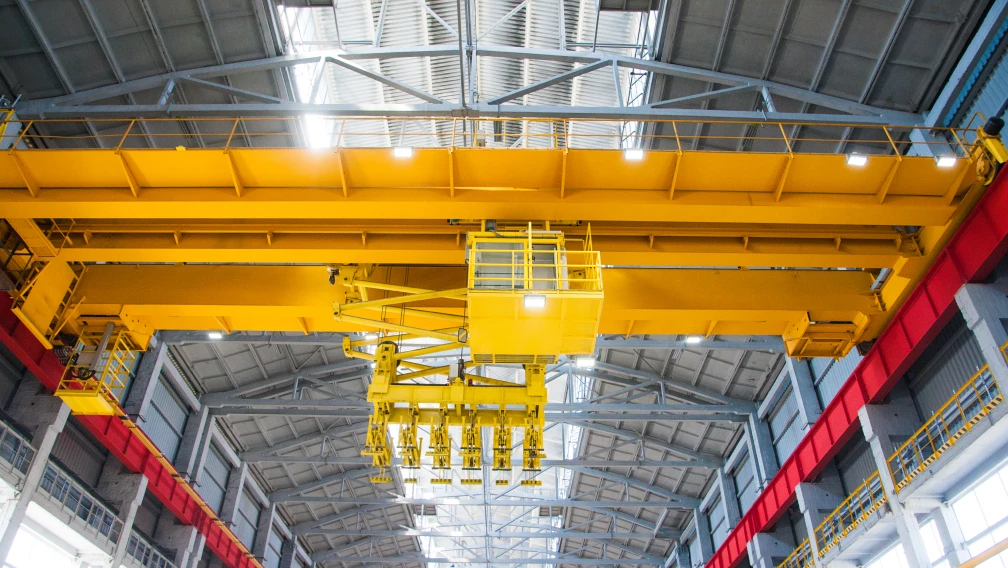
A Miniload crane consists of a vertical mast, a base carriage running on a floor rail, a top guide rail, and a lifting carriage equipped with a load handling device (LHD). The LHD typically utilizes telescopic forks, carton grippers, or belt-driven extraction mechanisms to pull the tote from the rack. The crane moves simultaneously in the X-axis (horizontal travel down the aisle) and the Y-axis (vertical hoist), executing a diagonal kinematic profile to reach the target coordinate.
Because the crane must carry the entire weight of its own mast and lifting carriage during every horizontal movement, heavy motors and large drives are required. To handle high buildings (often up to 20 meters), the mast must possess significant structural rigidity to limit deflection—the bending of the mast during high-speed acceleration or deceleration. If mast deflection exceeds precise millimeter tolerances, the LHD cannot align with the storage slot, forcing the crane to wait for the mast to settle before extracting the tote.
Throughput Constraints and Cycle Times
Throughput in a Miniload AS/RS is inherently capped by its aisle-captive nature. One crane can only be in one place at a time. The system's maximum output is strictly defined by the crane's travel speed and the length of the aisle. A typical high-performance Miniload can execute 100 to 140 dual cycles (putting away one tote and retrieving another in a single trip) per hour. If a facility requires more throughput from a specific aisle, the only physical solution is to shorten the aisle to reduce travel time, which directly decreases storage capacity. Miniload systems couple storage volume directly to throughput: increasing one often requires sacrificing the other.
Four-Way Shuttle Systems: Decoupling Storage from Throughput
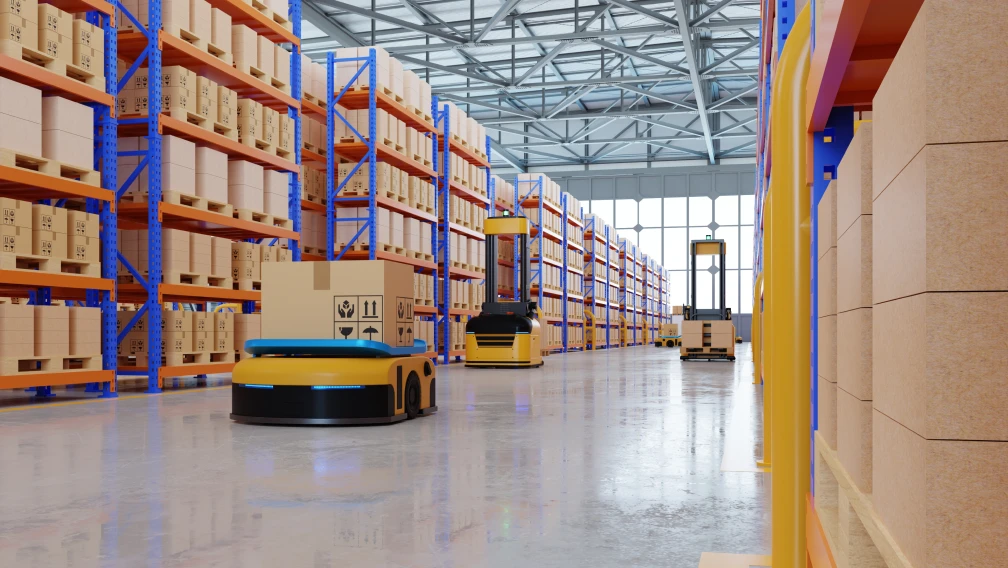
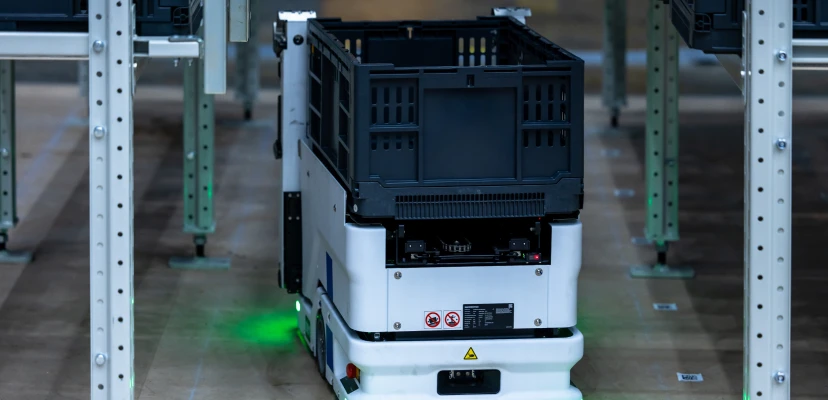
The Four-Way Shuttle architecture abandons the single-crane model. Instead of moving a heavy mast to the tote, it deploys a fleet of lightweight, autonomous robotic shuttles that travel directly into the racking structure, operating on both the X-axis (down the aisle) and the Z-axis (across the aisles).
Multi-Directional Movement and Vertical Lifts
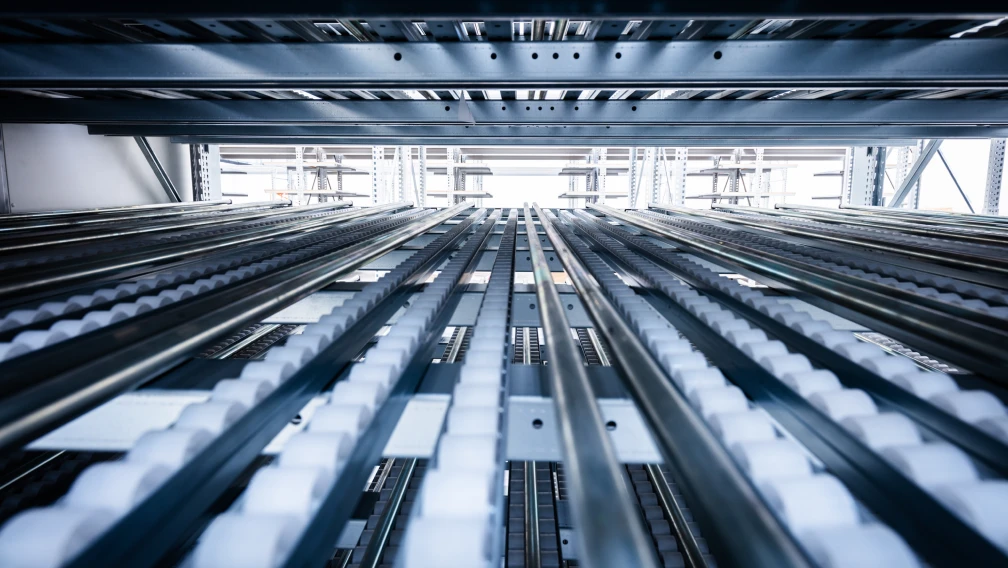
A four-way shuttle system separates horizontal and vertical movement into entirely distinct mechanical processes. The shuttle handles all horizontal travel. When it reaches an intersection within the rack grid, it engages a secondary set of wheels to change direction 90 degrees without rotating its chassis, allowing it to navigate deep into storage channels or cross over to adjacent aisles.
To move vertically, the shuttle drives onto a stationary high-speed elevator (lift) located at the periphery or end of the racking block. The lift acts purely as a vertical conveyor, moving shuttles or individual totes between the storage tiers and the input/output (I/O) level. This decoupling is the critical engineering advantage of the shuttle system. Because a shuttle weighs a fraction of a Miniload crane, it accelerates faster, consumes less energy, and subjects the rack structure to vastly lower dynamic loads.
Scalability and Fleet Expansion
Shuttle systems solve the capacity-throughput paradox. If a distribution center needs more storage volume, they extend the racking grid. If they need more throughput to feed faster picking stations, they simply introduce more shuttles onto the grid and add more vertical lifts. The fleet size scales independently of the physical storage footprint. High-performance shuttle grids can achieve throughputs exceeding 1,000 dual cycles per hour per aisle by utilizing multiple lifts and high shuttle densities per tier.
Comparative Engineering Analysis
Selecting between these frameworks dictates the facility's ability to handle peak order volumes, specifically during promotional events like Black Friday or Single's Day.
| Specification Parameter | Miniload AS/RS | Four-Way Shuttle System |
| Kinematic Principle | Aisle-captive, combined X/Y axis mast travel. | Grid-roaming fleet, separated horizontal (shuttle) and vertical (lift) travel. |
| Throughput Limits | 100 - 140 dual cycles per hour per aisle. Hard capped by crane speed. | Scalable. Can exceed 1,000 cycles per hour depending on shuttle and lift density. |
| System Redundancy | Low. A crane failure shuts down access to the entire aisle (both rack faces). | High. If one shuttle fails, the software routes other shuttles around it to maintain operations. |
| Energy Profile | High moving mass (entire mast). Requires heavy grid power. | Low moving mass. Shuttles use supercapacitors or lithium batteries, charging during idle time. |
| Footprint Flexibility | Requires long, unobstructed rectangular aisles. | Highly adaptable. The grid can be shaped around building columns or irregular walls. |
Software Orchestration: The Role of RCS and WMS
The mechanical advantages of a four-way shuttle system cannot be realized without complex software orchestration. While a Miniload WCS strictly manages the point-to-point logic of a single crane, a shuttle system requires advanced fleet management.
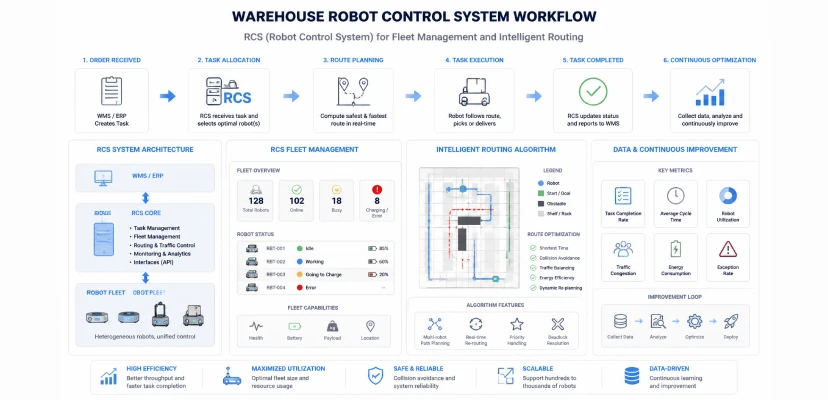
Our warehouse control software suite handles this at two levels. First, the Warehouse Management System (WMS) batches incoming orders and determines the optimal retrieval sequence to ensure the goods-to-person picking stations never sit idle. It communicates these demands to the Robot Control System (RCS).
The RCS acts as an air traffic controller for the shuttle fleet. It executes dynamic path planning, constantly calculating the fastest route for each shuttle while preventing collisions at grid intersections. It manages lift sequencing, ensuring that lifts are utilized efficiently without shuttles queuing for excessive periods. Furthermore, the RCS monitors the charge status of the supercapacitors or batteries onboard each shuttle, automatically routing them to charging rails during brief lulls in order volume. This continuous, real-time optimization is what translates raw mechanical speed into actual facility throughput.
System Redundancy and Maintenance
In retail and e-commerce distribution, downtime means missed shipping cutoffs and immediate financial penalties. The redundancy profiles of these two systems differ radically.
Because a Miniload crane is aisle-captive, a drive motor failure or sensor fault brings the entire aisle to a halt. Every SKU stored in that aisle becomes inaccessible until a technician enters the structure, applies Lock-Out/Tag-Out (LOTO) procedures, and completes the repair. Inventory must be heavily dispersed across multiple aisles to mitigate this single point of failure.
A four-way shuttle system inherently provides distributed redundancy. If an individual shuttle encounters a mechanical fault, the RCS immediately removes it from the active fleet logic. The system recalculates paths to route other active shuttles around the disabled unit. Maintenance personnel can safely retrieve the faulty shuttle from the grid using a specialized recovery vehicle without shutting down the entire storage block. The throughput of the facility drops fractionally (by the loss of one vehicle), rather than catastrophically.
Matching Architecture to Order Profiles
Procuring the right system requires analyzing the specific order profile of the facility. The Miniload AS/RS remains an excellent, cost-effective solution for manufacturing buffering or parts distribution where the required throughput is steady, predictable, and falls under 150 cycles per aisle per hour. It provides robust, high-density storage with a lower initial control software complexity.
However, for omnichannel fulfillment centers, fast-fashion distribution, or pharmaceutical operations facing extreme volume spikes and requiring massive parallel processing at picking stations, the Four-Way Shuttle system is the required architecture. By decoupling vertical and horizontal travel and allowing the fleet size to scale independently of the rack structure, it removes the mechanical bottleneck from the fulfillment process.
Designing a High-Density Fulfillment Buffer
Transitioning from manual picking or upgrading a legacy AS/RS requires precise capacity modeling. A system designed on peak-day assumptions will be overbuilt and too expensive; a system built on average-day volumes will fail during peak season.
HOWEPROFIT approaches these projects through data simulation. We ingest your historical order line data, SKU dimensions, and required outbound shipping windows. We simulate the performance of both Miniload and Shuttle configurations against your data, providing empirical cycle times and footprint requirements before any hardware is specified. This ensures the mechanical architecture exactly matches the physical reality of your material flow.
→ Contact HOWEPROFIT's engineering group to initiate a simulation study for your automated distribution center.
-

HOWEPROFIT Team
Warehouse Automation Specialists, HOWEPROFIT
The HOWEPROFIT Team consists of senior intralogistics engineers and supply chain experts specializing in advanced AS/RS and robotic fulfillment solutions. Backed by years of field experience across e-commerce, 3PL, and manufacturing sectors, we provide data-driven automation strategies, rigorous throughput simulations, and objective ROI modeling. Our mission is to help facilities seamlessly transition to high-efficiency, reliable, and scalable automated operations.