The Thermodynamic and Operational Crisis in Cold Chain
Operating a deep-freeze distribution center—typically running between -18°C and -30°C to preserve food, pharmaceuticals, or biological materials—is fundamentally a battle against thermodynamics and human physiological limits. In a conventional manual cold storage facility, the highest recurring operational expenditure is refrigeration. The mechanical plant must constantly remove heat from a massive volume of air, much of which is empty aisle space required for forklift maneuverability.
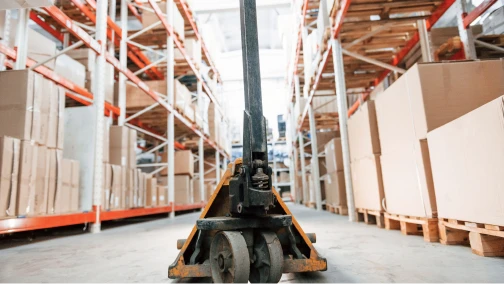
Simultaneously, human labor in sub-zero environments is difficult to source, expensive to maintain, and inherently inefficient. Operators require frequent warming breaks, typically working in cycles of 45 minutes inside the freezer followed by 15 minutes of recovery. Thick thermal protective equipment limits dexterity, reducing picking speed and increasing handling errors. When forklift drivers move between ambient loading docks and deep-freeze zones, thermal bridging and moisture ingress create dangerous ice accumulation on the floor and racking structure.
Implementing Automated Storage and Retrieval Systems (AS/RS) in cold environments solves both the thermodynamic and labor constraints. By maximizing storage density, an AS/RS drastically reduces the cubic volume of the building, cutting energy consumption per pallet by up to 40%. However, standard automation equipment fails catastrophically at -25°C. Deploying robotics in a freezer requires specific metallurgical, electrical, and tribological engineering. This document details the physical challenges of sub-zero intralogistics and the architectural solutions required to maintain high throughput in extreme cold.
Mechanical Engineering for Deep-Freeze Environments
Equipment designed for an ambient warehouse cannot simply be installed in a cold store. The physical properties of steel, lubricants, plastics, and electronics undergo severe alterations when the ambient temperature drops below zero.
Metallurgy and Structural Integrity
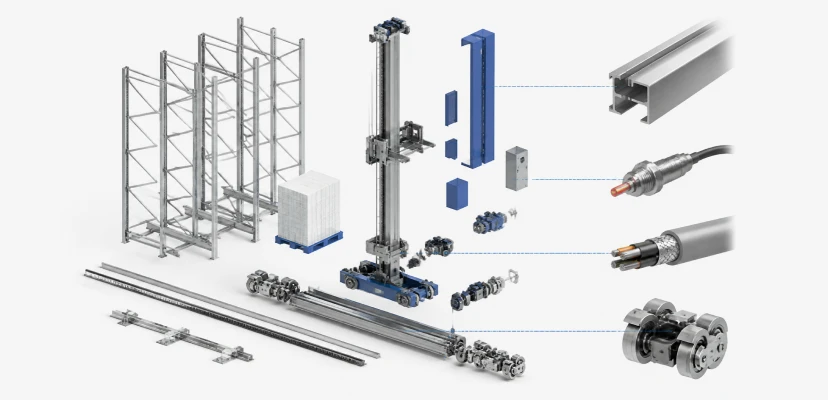
The primary concern for any load-bearing structure—such as a stacker crane mast or high-bay racking—is the ductile-to-brittle transition temperature of the steel. Standard carbon steel utilized in ambient pallet racking becomes brittle at sub-zero temperatures, meaning it is susceptible to sudden structural failure or fracturing upon impact, rather than bending or deforming. Cold-storage AS/RS structures must be manufactured using specialized low-temperature structural steels (e.g., high-tensile, micro-alloyed steels with verified notch toughness at -30°C). Welding processes also require specific protocols, as rapid cooling of the weld pool in a cold environment induces thermal stress and cracking.
Lubrication and Drive Systems
Tribology, the science of friction and lubrication, dictates the performance of AS/RS drive units. Standard industrial greases and oils freeze or reach excessive viscosity at -25°C. When a gearmotor operates with frozen lubricant, the mechanical resistance causes the motor to draw excessive current, leading to tripped breakers, blown fuses, or burned stators. Cold-rated AS/RS equipment utilizes synthetic, low-viscosity, silicone-based, or PAO (polyalphaolefin) lubricants designed specifically to maintain their shear properties at extreme low temperatures. Furthermore, drive motors and gearboxes are often equipped with internal heating elements to maintain the lubricant within optimal operational parameters during prolonged idle periods.
Sensors, Cables, and Control Electronics
Control systems rely on optical sensors, barcode scanners, and continuous data transmission. At -30°C, the PVC jacketing on standard electrical cables becomes rigid and shatters under repeated flexing, such as the constant bending required in a stacker crane's cable track. Cold-rated automation utilizes PUR (polyurethane) or specialized elastomer cables that retain flexibility.
Optical sensors face the threat of condensation and frost. When minute temperature fluctuations occur, moisture rapidly condenses and freezes on laser scanner lenses or photoelectric reflectors, blinding the system. To counter this, all critical optical components, PLCs (Programmable Logic Controllers), and onboard control cabinets are enclosed in hermetically sealed, actively heated housings.
| Component Category | Standard Ambient Specification | Cold-Rated Specification (-30°C) |
| Structural Steel & Mast | Standard Carbon Steel (e.g., Q235, S235) | Low-Temp Alloy Steel with Charpy V-Notch testing |
| Lubricants | Mineral-based industrial gear oil & grease | Synthetic PAO / Silicone low-viscosity greases |
| Cabling & Festoons | PVC jacketing | PUR (Polyurethane) or specialized cold-flex elastomer |
| Control Cabinets & Sensors | IP54 enclosures, passive cooling | IP65 enclosures, active integrated heating circuits |
Architectures for Cold Storage Automation
Depending on the required SKU profile and throughput, specific automated layouts provide the best balance of density and access.
High-Bay Unit-Load AS/RS
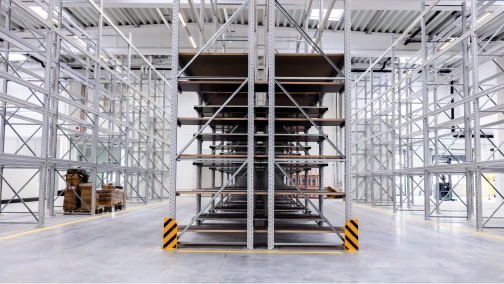
For operations requiring massive capacity and high throughput with continuous access to every individual pallet, the crane-based Unit-Load AS/RS is the standard architecture. Utilizing single- or double-deep racking, stacker cranes handle extreme vertical heights (up to 35 meters). By building vertically, the facility minimizes its footprint. Because thermal loss through the roof and walls is directly proportional to surface area, a tall, dense footprint requires significantly less refrigeration tonnage than a sprawling, low-clearance manual warehouse.
Deep-Lane Pallet Shuttle Systems
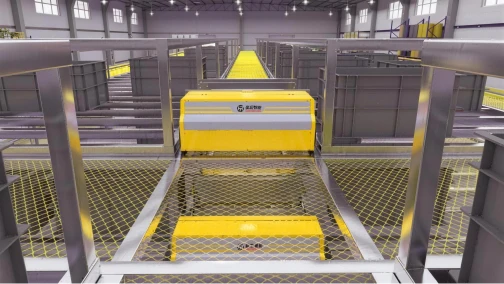
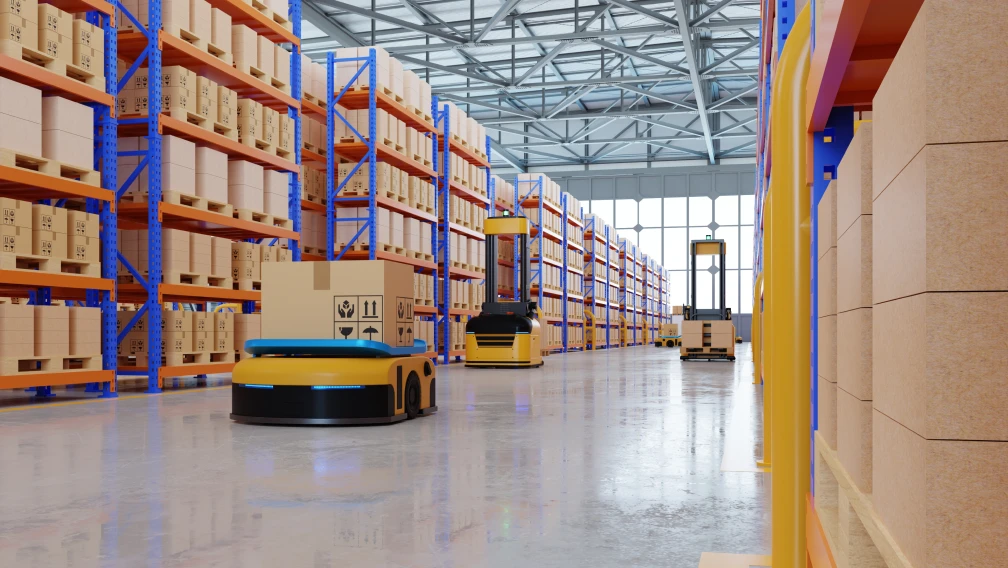
Food manufacturing and beverage industries often produce massive volumes of a limited number of SKUs. In these scenarios, individual pallet accessibility is less critical than absolute storage density. A Pallet Shuttle system provides deep-lane storage, where pallets are stored 10 to 20 deep in a channel. A cold-rated autonomous robotic shuttle drives under the pallet, lifts it, and transports it to the front of the channel where a stacker crane or an operator retrieves it. This architecture eliminates almost all aisle space, creating a solid block of inventory and achieving the highest possible volumetric efficiency. Cold-rated shuttles utilize specialized lithium titanate or heated lithium-ion battery cores capable of discharging and recharging reliably in deep freeze.
Automated Mobile Pallet Racking
For existing facilities (brownfield projects) where ceiling height prohibits the installation of a high-bay AS/RS, mobile pallet racking provides an excellent semi-automated upgrade path. The racking is mounted on heavy-duty motorized bases that slide along tracks embedded in the freezer floor. Only one operating aisle is open at any given time. When an operator requires access to a specific aisle, the control system drives the racks apart to open that specific corridor. While it requires manual forklift intervention for the final pick, mobile racking typically recovers 40% to 50% of the space lost to static aisles without requiring a complete building reconstruction.
Thermal Zoning and Airlock Management
An automated freezer must be isolated from the rest of the facility to prevent thermal leakage and ice formation. Condensation occurs when warm, humid air meets cold surfaces. If automation equipment—or the inventory itself—is exposed to ambient air without proper staging, immediate frost accretion occurs.
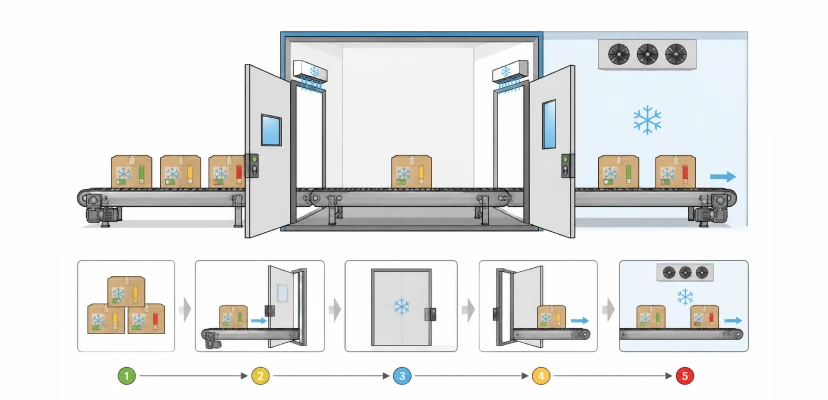
Material flows in and out of the deep-freeze zone via automated conveyor airlocks. The WCS (Warehouse Control System) manages heavy-duty, high-speed insulated roll-up doors. As a pallet approaches on the conveyor, the outer door opens, the pallet enters the insulated vestibule, and the outer door closes. The vestibule undergoes a rapid dehumidification cycle to strip moisture from the air before the inner door opens, allowing the pallet to enter the -25°C zone. This automated double-door protocol prevents external humidity from entering the freezer, entirely eliminating the dangerous and equipment-destroying ice build-up typical of manual forklift entryways.
FEFO Logic and Software Orchestration
In cold chain logistics, inventory is highly perishable. Standard FIFO (First-In-First-Out) logic is insufficient, as production batches may have varying shelf lives based on upstream processing conditions. The warehouse management system must enforce strict FEFO (First-Expired-First-Out) logic.
Our Warehouse Management System tracks batch numbers, exact production times, and expiration dates at the individual pallet or carton level. The WMS determines the retrieval sequence solely based on expiration proximity. If a specific batch of frozen goods is flagged during quality control, the WMS executes an immediate quarantine protocol, logically locking the inventory within the AS/RS so the cranes or shuttles cannot retrieve it for shipping, ensuring total compliance with food safety regulations.
Maintenance Strategies in the Deep Freeze
Equipment failure in a cold store requires technicians to execute repairs in hostile conditions. Cold storage AS/RS networks are engineered to minimize the duration of in-freezer maintenance.
First, redundancy is prioritized. If a crane or shuttle faults, the software dynamically reroutes tasks to operational aisles. Second, control cabinets and critical diagnostic panels are located outside the freezer zone whenever possible, allowing technicians to troubleshoot software and PLC faults in ambient temperatures. For mechanical repairs on autonomous shuttles, the system automatically dispatches a recovery vehicle to extract the faulted shuttle and transport it to a heated maintenance vestibule. For stacker cranes, components are designed in modular, quick-swap configurations. A technician enters the freezer only to swap out a failed motor assembly in minutes, rather than executing complex teardowns and rebuilds at -25°C.
Validating the Cold Storage Business Case
The capital expenditure for a cold-rated AS/RS is offset by three distinct operational savings: a drastic reduction in refrigeration energy consumption due to volumetric density, the elimination of premium labor costs associated with sub-zero manual operations, and the virtual eradication of product loss due to temperature deviations or FEFO failures.
Evaluating the correct architecture requires mapping your SKU velocity against the structural constraints of the building and the thermal requirements of the mechanical plant.
→ Contact HOWEPROFIT’s engineering team to initiate a structural and material flow analysis for your cold storage facility.
-

HOWEPROFIT Team
Warehouse Automation Specialists, HOWEPROFIT
The HOWEPROFIT Team consists of senior intralogistics engineers and supply chain experts specializing in advanced AS/RS and robotic fulfillment solutions. Backed by years of field experience across e-commerce, 3PL, and manufacturing sectors, we provide data-driven automation strategies, rigorous throughput simulations, and objective ROI modeling. Our mission is to help facilities seamlessly transition to high-efficiency, reliable, and scalable automated operations.