Four Acronyms, One Warehouse
WMS, WCS, WES, RCS. Four acronyms that get used interchangeably in sales decks and mixed up in RFPs, even though each names a different layer of software doing a different job. Get the distinction wrong and you either overbuy — paying for orchestration you don’t need — or underbuy, bolting robots onto a system that can’t coordinate them.
This guide separates the four cleanly: what each system does, where they overlap, how they connect, and which ones your operation actually needs. It’s written for operations and supply-chain leaders scoping a warehouse automation project, not for software engineers.
The short version: a WMS plans, a WES orchestrates, and a WCS and RCS execute. The first two decide what should happen; the last two make equipment do it. Everything below expands on that.
The Four Layers at a Glance
Before the detail, here is how the layers stack up:
| System | What it does | Works over | What it controls |
| WMS | Inventory and order planning | Minutes to hours | Data and people (tasks) |
| WES | Real-time work orchestration | Seconds to minutes | Order flow across people and machines |
| WCS | Equipment command and control | Milliseconds to seconds | Fixed automation: conveyors, sorters, cranes, ASRS |
| RCS | Robot fleet coordination | Milliseconds to seconds | Mobile robots: AMRs, AGVs, shuttles |
Data flows down the stack as instructions and back up as status. A single warehouse may run all four, or just one, depending on how automated it is.
WMS — the Planning Brain
The warehouse management system is the layer most operations start with, and the system of record for inventory and orders.
What a WMS does
A WMS manages the flow of goods into, through, and out of the building: receiving and put-away, storage locations, order allocation, picking, packing, shipping, replenishment, cycle counts, and returns. It assigns tasks to workers, tracks inventory in real time, and connects upward to ERP and to e-commerce or marketplace platforms. Its decisions run on a horizon of minutes to hours — which orders to release, where to slot stock, how to balance labor across a shift.
In one line: a WMS decides what needs to happen and where inventory lives, and keeps the inventory record accurate.
What a WMS doesn’t do
A WMS doesn’t drive machinery. It won’t start a conveyor, route a tote to a specific divert, or tell a stacker crane which aisle to enter. It plans at the order and task level; the moment execution depends on machine-level timing, the WMS hands off to a lower layer. Run automation off a WMS alone and you get plans with nothing to carry them out at machine speed.
WCS — the Equipment Controller
What a WCS does
The warehouse control system is the device layer. It translates instructions into equipment commands and coordinates fixed automation in real time — conveyors, sortation, palletizers, stacker cranes, and AS/RS. It runs deterministic control: start this motor, route this carton to lane four, index this crane to bay twelve, and report status back. Where a WMS thinks in orders, a WCS thinks in signals and milliseconds.
Where a WCS stops
A WCS is built for deterministic, pre-planned flows. It is excellent at executing a fixed sequence and weak at reacting when conditions change. When an order jumps the queue, a zone falls behind, or a machine goes down, static WCS logic can’t re-optimize the whole operation on the fly. That gap is what created the next layer.
WES — the Real-Time Orchestrator
Why the WES emerged
The warehouse execution system is the newest of the four, and it exists to fill the gap between WMS planning and WCS execution. A WMS releases work in waves or batches; a WCS runs equipment. Neither continuously re-optimizes the whole floor second by second. As warehouses added more automation and faster order profiles, that gap started costing throughput.
What a WES optimizes
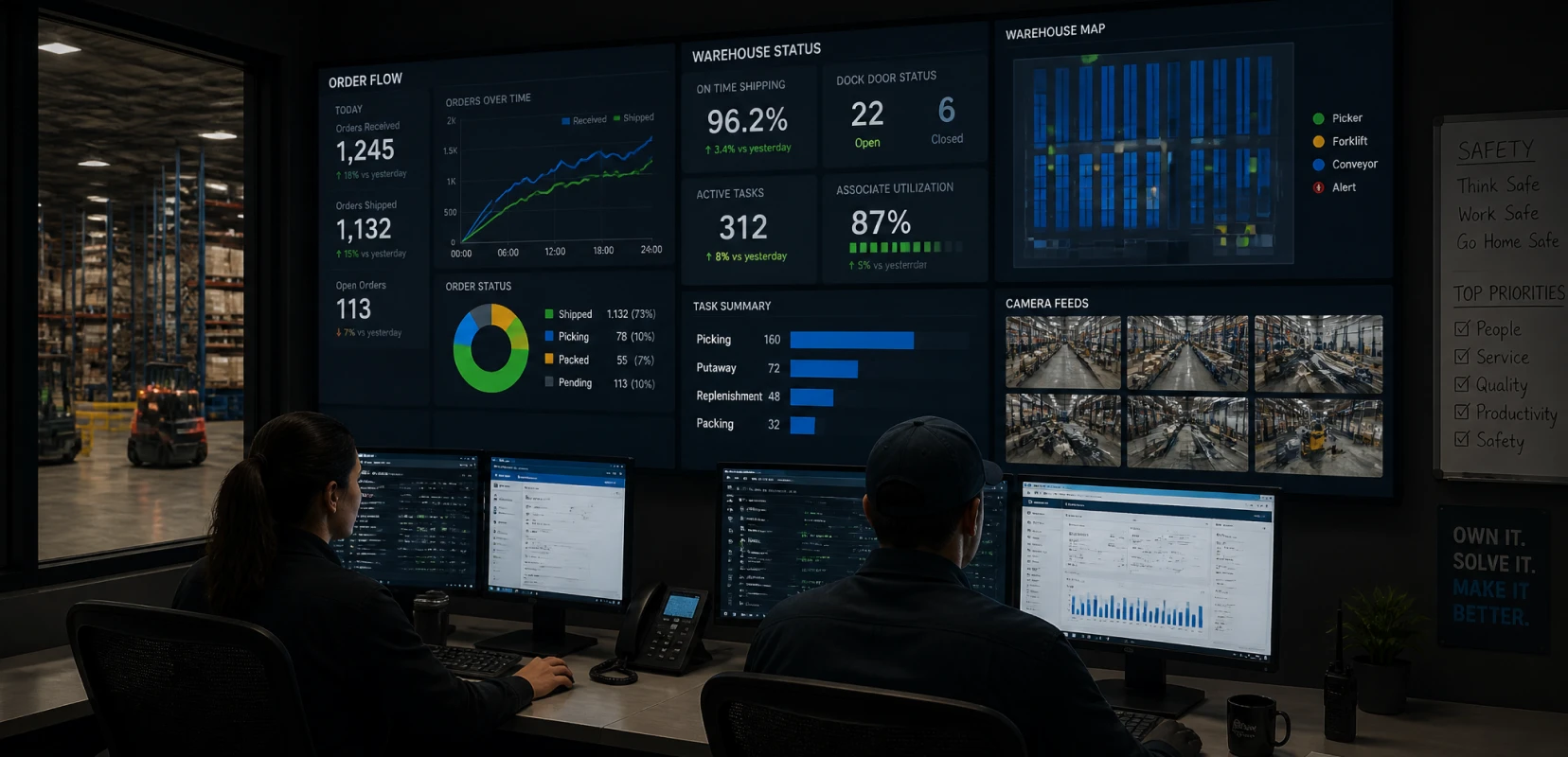
A WES makes moment-by-moment decisions across people and machines at once: which order to prioritize, how to sequence and batch picks, which resource — a worker, a shuttle, a conveyor — should take each task given current conditions, and how to rebalance when a rush shipment lands. The goal is to keep every resource busy and every order moving, cutting the idle time and transfer-point bottlenecks that appear when subsystems run in isolation.
In one line: a WES decides, in real time, how work is executed across the whole warehouse so no resource sits idle and no order stalls.
WES vs WCS — the part everyone confuses
This is the most common mix-up. A WCS controls equipment; a WES orchestrates work. A WCS answers “how do I run this conveyor”; a WES answers “given everything happening right now, what should happen next, and who does it.” In practice the lines blur — some WES products absorb WCS functions into a single engine, and some vendors label the same software differently. The useful test is scope: if it is coordinating one type of equipment, it is acting as a WCS; if it is balancing the whole operation across people, machines, and changing priorities, it is acting as a WES.
RCS — the Robot Fleet Layer
What an RCS does
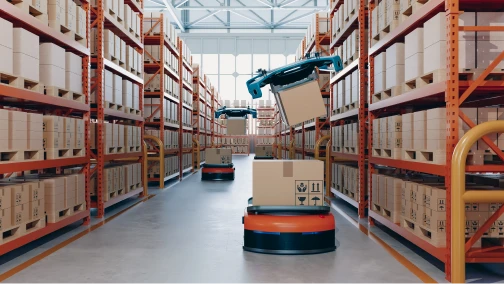
As mobile robots entered the warehouse, they needed their own coordinator. A robot control system (also called fleet management) coordinates a fleet of AMRs, AGVs, or shuttles as one unit: allocating each task to the best-placed robot, managing traffic and routing so robots don’t deadlock, scheduling charging around battery levels and queue depth, and — increasingly — coordinating robots from more than one vendor through a single interface.
RCS vs WCS
An RCS is to mobile robots what a WCS is to fixed automation — the execution layer for its equipment class. The industry grew the two in parallel: WCS expanded to orchestrate multiple types of fixed automation, and fleet-management software is now doing the same for mixed robot fleets. In many modern systems the RCS sits under a WES or is folded into an integrated control platform, so robots, cranes, and conveyors act as one coordinated operation instead of separate islands.
How the Four Layers Work Together
In a fully automated warehouse, the stack runs top to bottom:
1. ERP passes orders and the inventory master down to the WMS.
2. WMS plans — allocates stock, releases orders, assigns tasks.
3. WES orchestrates — turns those plans into real-time, optimized instructions across people and machines.
4. WCS and RCS execute — the WCS drives fixed automation, the RCS drives the robot fleet.
5. Status flows back up — equipment reports to the WCS and RCS, which report to the WES and WMS, which update inventory and ERP.
Not every warehouse runs all five as separate software. Smaller or simpler operations collapse layers — a WMS with a light WCS, or an integrated platform that covers planning and robot control in one engine. The layers describe functions, not a mandatory shopping list of four separate products.
Do You Need All Four?
Short answer: almost no one needs four separate systems, but every automated warehouse needs the functions. Match the software to how automated you are.
• Manual or lightly automated warehouse. A WMS is usually enough. Inventory, orders, and task direction cover it, and there is little equipment to control.
• Warehouse with fixed automation. Add a WCS to drive conveyors, sorters, and ASRS, sitting under the WMS.
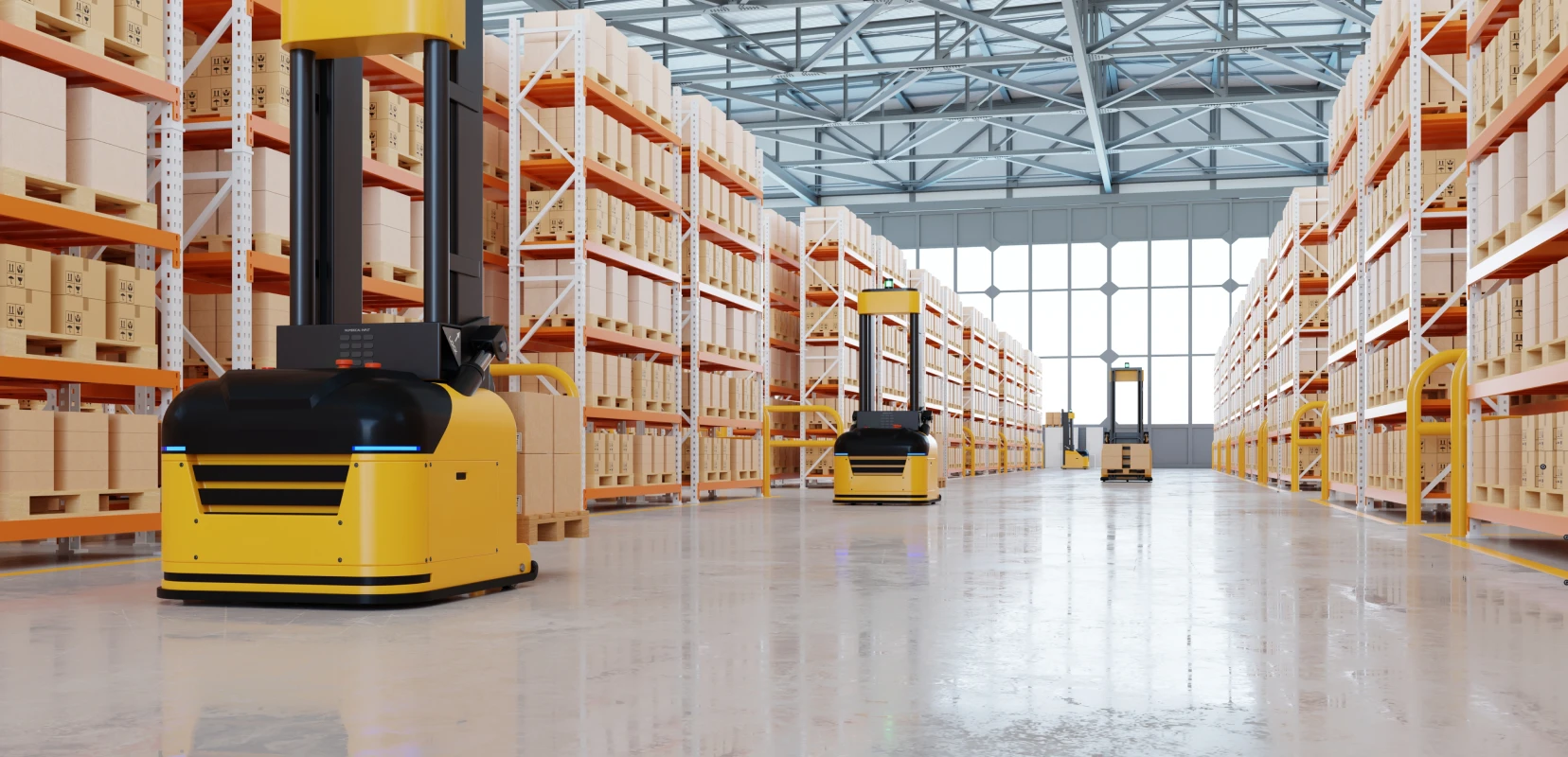
• Robot-based warehouse. You need an RCS or fleet manager to coordinate the AMRs, shuttles, and bin robots. Many systems ship this as part of the automation.
• Complex, high-velocity, multi-system operation. When fixed automation, robots, and manual stations all run together at high order volume, a WES earns its place. It is the layer that keeps them coordinated instead of bottlenecking at the handoffs.
The practical rule: buy for the coordination problem you actually have. Overbuying orchestration for a simple operation wastes money; running robots without a fleet layer wastes the robots.
How HOWEPROFIT Handles the Software Stack
We build our automation systems around an integrated software platform rather than a stack of disconnected products. Our warehouse management system and robot control system are designed to run as one engine — the WMS handles inventory, orders, and allocation, while the RCS schedules and routes the robot fleet, so planning and execution stay in sync. Open interfaces let the platform connect to a customer’s existing WMS or ERP through standard APIs, so it can run a whole operation or slot in as the control and orchestration layer under software you already have.
That integration is what makes our bin robots, miniload, and four-way shuttles operate as a coordinated fleet instead of separate machines — the software decides which robot takes each task, manages traffic, and keeps retrieval matched to the order flow. If you are weighing the hardware side too, our guides on what AS/RS is and warehouse automation ROI cover the equipment and the payback. When you are ready to map software to a planned system, our engineers can help you scope the right layers — talk to our team.
Frequently Asked Questions
What’s the difference between a WMS and a WCS?
A WMS plans and manages inventory and orders — receiving, put-away, allocation, picking, and shipping — at the order and task level. A WCS controls physical equipment in real time, translating instructions into machine commands for conveyors, sorters, and cranes. The WMS decides what should happen; the WCS makes the equipment do it.
Is a WES the same as a WCS?
No, though they are often confused. A WCS controls equipment; a WES orchestrates work across the whole warehouse in real time — sequencing orders, allocating tasks to people or machines, and rebalancing when conditions change. Some WES products include WCS functions, but the WES role is decision-making, not just device control.
What does an RCS (robot control system) do?
An RCS, or fleet manager, coordinates a fleet of mobile robots — AMRs, AGVs, or shuttles. It assigns tasks to the best-placed robot, manages traffic and routing, schedules charging, and can coordinate robots from multiple vendors. It is the execution layer for mobile robots, much as a WCS is for fixed automation.
Do I need all four systems?
Rarely as four separate products. A manual warehouse usually needs only a WMS. Add a WCS for fixed automation and an RCS for robot fleets. A WES becomes worthwhile in complex, high-volume operations that mix fixed automation, robots, and manual work and need real-time coordination across all of them. Match the software to your level of automation.
How do these systems connect to my ERP?
The ERP sits above the WMS, passing orders and inventory data down and receiving status back. The WMS plans, a WES (if present) orchestrates, and the WCS and RCS execute on equipment, with status flowing back up to the WMS and ERP. Integration is usually through standard APIs.
Can one platform cover several of these layers?
Yes, and many modern systems do. Integrated platforms combine WMS planning with robot control, or fold WCS and WES functions into a single engine, so fewer separate products have to be integrated. What matters is that all the functions are covered and the layers talk to each other cleanly.
Is a WMS the same as an ERP?
No. An ERP runs company-wide business processes — finance, procurement, sales, and high-level inventory. A WMS runs the warehouse in operational detail — where each item sits, how orders are picked, how labor and equipment are directed. They connect, but the WMS handles a depth of warehouse execution an ERP isn’t built for.
-

HOWEPROFIT Team
Warehouse Automation Specialists, HOWEPROFIT
The HOWEPROFIT Team consists of senior intralogistics engineers and supply chain experts specializing in advanced AS/RS and robotic fulfillment solutions. Backed by years of field experience across e-commerce, 3PL, and manufacturing sectors, we provide data-driven automation strategies, rigorous throughput simulations, and objective ROI modeling. Our mission is to help facilities seamlessly transition to high-efficiency, reliable, and scalable automated operations.