Search

Enter keywords to search for products, blog posts, and more.

High-Speed Bin Robot for Automated Warehouse Storage

Four-Way Shuttle System for Tote & Carton Storage


Multidirectional Four-Way Travel

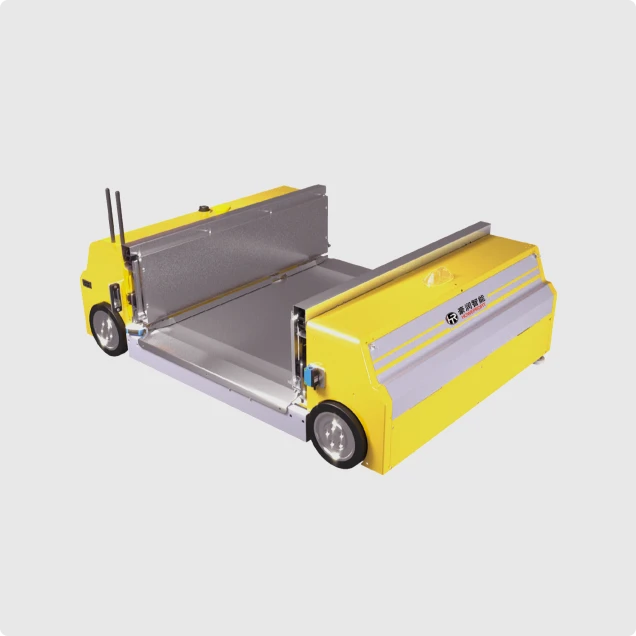
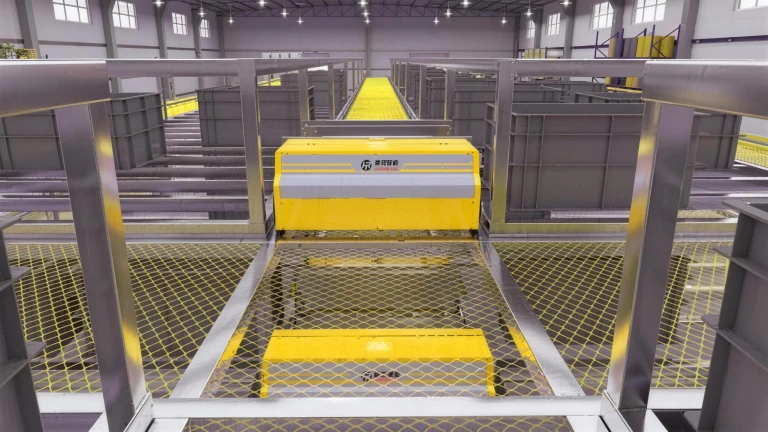
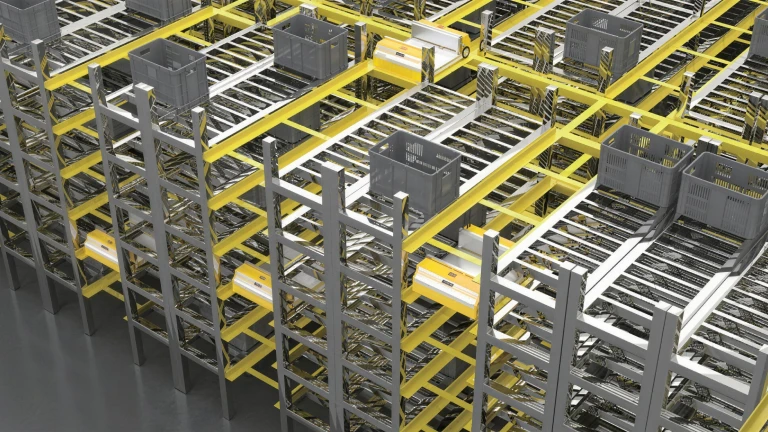
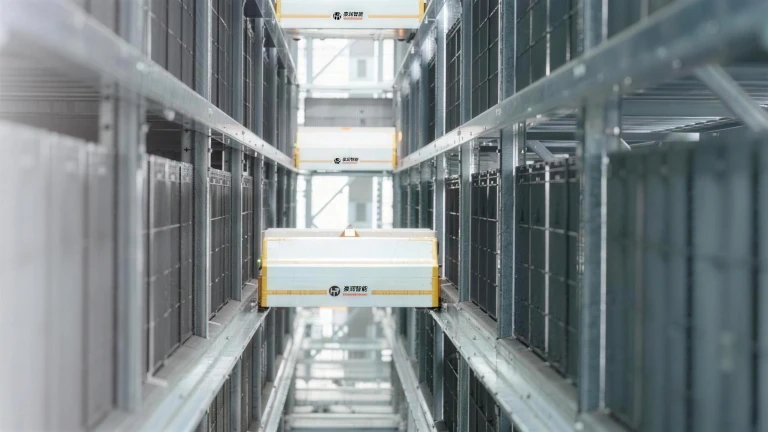
Shuttles run forward, backward, left, and right across the rack grid, and reach any level through vertical lifts. One fleet covers a full 3D storage block, switching aisles on its own to keep totes moving without the single-aisle limit of a crane.


Ten-Second Super-Capacitor Charge

Super-capacitor power charges in about 10 seconds at the transfer point — no battery swaps, no charging bays, no downtime. Shuttles top up between moves and keep working, which is where battery-powered shuttles and AMRs lose hours each week.


Fleet Throughput, Built-In Backup

A fleet of shuttles works in parallel, lifting throughput to 3-4 times a single-crane ASRS for the same storage. Any shuttle can cover any location, so an idle unit picks up the next task and the system keeps running even if one is pulled for service.


Goods-to-Person Tote Handling

Telescopic forks pick and place on both sides at ±1mm, feeding goods-to-person stations instead of sending people to search the racks. The result is faster picking, fewer errors, and steady flow through peak order periods.


Goods-to-Person Tote Handling

Four-Way Shuttle Tote & Pallet Versions 10s Fast Charge ±1mm Precision 3-4x Throughput WMS/WCS Integrated

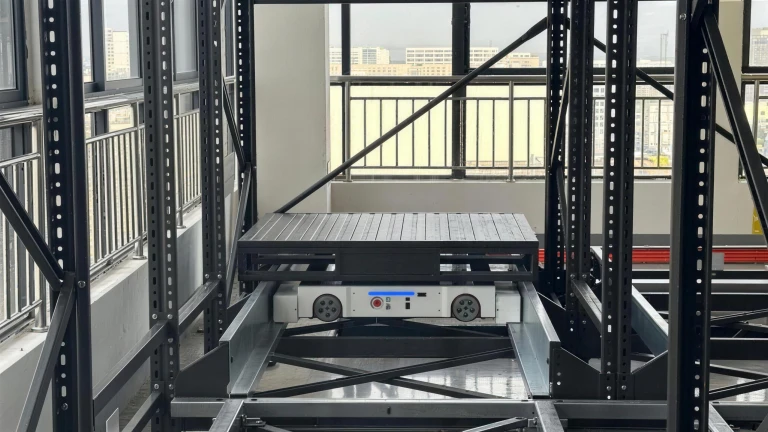
HOWEPROFIT four-way shuttle system is a multidirectional shuttle ASRS for fast, dense storage of totes and cartons. A fleet of shuttles runs on rack rails — forward, backward, left, and right — and reaches every level through vertical lifts, so the whole storage block is one connected grid. Super-capacitor power charges in about 10 seconds, shuttles travel at 4 m/s with ±1mm positioning, and the system runs goods-to-person picking under WMS/WCS. Available in light-tote shuttles for loads up to 50kg and pallet-type shuttles up to 2,000kg, across two-way, four-way, and variable-distance versions, it delivers 3-4 times the throughput of a single-crane ASRS in a flexible, modular layout that fits any floor or mezzanine.


· True four-way travel plus lift-served access to every level
· Super-capacitor power, ~10-second charge, no charging downtime
· 4 m/s travel speed with ±1mm positioning accuracy
· Fleet parallelism: 3-4x throughput of a single-crane ASRS
· Telescopic forks pick and place on both sides
· Two-way, four-way, and variable-distance shuttle versions
· Light-tote versions: 40kg rated / 50kg max per tote, 600×400 to 800×600mm bins
· Pallet-type four-way shuttles available up to 2,000kg per load
· Interchangeable shuttles back each other up — no single point of failure
· Flexible, modular layout for warehouses, mezzanines, multi-level plants
· Goods-to-person picking, fully integrated with WMS/WCS

Engineering & Support


Layout & Design: grid and lift sizing, fleet count, tote handling, and WMS/WCS interface
Lead Time: around 90-120 days from approved layout to commissioning
Installation: rack, rail, lift, and shuttle install with run-in testing and operator training
Warranty: 12 months on parts and labor, plus ongoing engineering support
Support: 24/7 remote diagnostics, with engineers on site within 48 hours
Spares: shuttle wear parts and modules held in stock for fast dispatch

Specifications

ModelGroup 604_1x.webp
Four-Way Shuttle
Single / Double Depth
ZQ2104-D/S
Group 605_1x.webp
Four-Way Shuttle
Single Depth
ZQ2105-D
Group 604_1x.webp
Two-Way Shuttle
Single / Double Depth
ZQ2101-D/S
Group 604_1x.webp
Variable-Distance Shuttle
Double Depth
ZQ2103-S
Shuttle TypeFour-wayFour-wayTwo-wayVariable-distance
Fork DepthSingle / double depthSingle depthSingle / double depthDouble depth
External Dimensions (L×W×H mm)966×746×3351128×896×335966×746×3181408×974×345
Vehicle Weight95kg95kg95kg120kg
Tote Size (L×W×H mm)600×400×400800×600×400600×400×400800×600×400
Rated Load per Tote40kg40kg40kg40kg
Max Load per Tote50kg50kg50kg50kg
Max Travel Speed4 m/s4 m/s4 m/s4 m/s
Travel Acceleration2.9 m/s²2.9 m/s²2.9 m/s²2.9 m/s²
Single-Tote Pick Time6-7 s6 s6-7 s6 s
Positioning Accuracy±1mm±1mm±1mm±1mm
Aisle Width766mm916mm766mm1004mm
Power SupplySuper-capacitorSuper-capacitorSuper-capacitorSuper-capacitor
Charging ModeReady to charge and useReady to charge and useReady to charge and useReady to charge and use
Charging Time10 s10 s10 s10 s
Runtime per Charge5-8 min5-8 min5-8 min5-8 min
Drive ModeServo-driveServo-driveServo-driveServo-drive
Positioning MethodEncoder + photoelectricEncoder + photoelectricEncoder + photoelectricEncoder + photoelectric
Operating Temperature-10–45°C-10–45°C-10–45°C-10–45°C
CommunicationEthernetEthernetEthernetEthernet
Control SystemWMS/WCSWMS/WCSWMS/WCSWMS/WCS

The models above cover light-tote handling up to 50kg. Heavy pallet-type four-way shuttles for loads up to 2,000kg are also available.


Application Scenarios

Peak-Season E-commerce Fulfillment

Cold & Freezer Storage

Multi-Level & Mezzanine Layouts


True Four-Way Grid Movement

A crane works one aisle on a fixed mast. A four-way shuttle roams the whole rack grid — forward, backward, left, right — and changes levels through vertical lifts. That turns a block of racking into one connected storage area where any shuttle reaches any tote, with no aisle locked to a single machine.

· Forward/backward + left/right travel
· Level changes via vertical lifts
· Full 3D access to every location
· Telescopic forks pick both sides


No Charging Downtime

Battery shuttles stop to charge or swap packs, and AMRs queue at charging bays. These shuttles use super-capacitor power that charges in about 10 seconds at the transfer point, topping up between moves. There are no battery bays, no swap stations, and no shifts lost to charging.

· Around 10-second fast charge
· Charges between moves, no downtime
· No battery swap or charging bays
· Lower long-term maintenance


Scale Throughput by Adding Shuttles

With a crane, throughput is tied to one machine per aisle. With shuttles, you add units to the same grid and throughput climbs — up to 3-4 times a single-crane ASRS for the same footprint. The system dispatches idle shuttles to the next task, so capacity follows demand instead of rebuilding aisles.

· 3-4x throughput vs crane ASRS
· Add shuttles, not aisles
· Auto-dispatch of idle units
· Cross-aisle parallel operation


Redundant, No Single Point of Failure

A single crane is a single point of failure — if it stops, the aisle stops. In a shuttle fleet every unit is interchangeable, so pulling one for service leaves the rest running. Modular, standardized shuttles back each other up, which keeps the system available during maintenance and peak load.

· Interchangeable shuttle fleet
· Keeps running during service
· No aisle-level shutdown
· Modular, standardized units

More About HOWEPROFIT

HOWEPROFIT is a warehouse automation system integrator with 15+ years of experience serving manufacturers and logistics operations. Our integrated solutions combine WMS/RCS software, warehouse robots, and automation equipment to maximize space efficiency and operational productivity. With 60%+ R&D personnel, we've delivered 600+ projects across 100+ industries, specializing in electronics, pharmaceuticals, e-commerce, textiles, and manufacturing sectors.

About Us Certifications Solutions

FAQs

What is a four-way shuttle and how does it move?

A four-way shuttle is an automated robot that runs on rack rails and moves in four directions — forward, backward, left, and right — instead of the two directions of a standard shuttle. Combined with vertical lifts, it reaches any level, giving full three-dimensional access to the storage grid. Light-tote versions carry totes and cartons up to 50kg while pallet-type versions handle loads up to 2,000kg, traveling at 4 m/s with ±1mm positioning, and works under WMS/WCS for goods-to-person picking.

How is a four-way shuttle different from a stacker crane?

A stacker crane works one aisle on a fixed vertical mast, so throughput is tied to that single machine. A four-way shuttle fleet roams the whole grid and is served by lifts, so many shuttles work in parallel and any unit reaches any location. This brings higher throughput, flexible aisle use, and redundancy, since pulling one shuttle for service leaves the rest running. A crane usually wins on lower entry cost for a single aisle.

What are the benefits of super-capacitor power?

Super-capacitor power charges in about 10 seconds at the transfer point, so shuttles top up between moves rather than sitting on a charger or waiting for a battery swap. That removes charging downtime, battery bays, and swap stations, and it works well in cold storage where batteries lose capacity. Maintenance is also lower because there are no battery packs to replace.

How much can a four-way shuttle system scale?

Capacity scales by adding shuttles to the same grid rather than building new aisles. A fleet can reach 3-4 times the throughput of a single-crane ASRS for the same footprint, and the control system dispatches idle shuttles to the next task automatically. You can start with the throughput you need today and add units as order volume grows.

Can it integrate with our WMS or WCS?

Yes. The shuttle fleet runs under a WMS/WCS layer that connects over standard Ethernet and coordinates storage, retrieval, and cross-aisle tasks in real time. It exchanges inventory and order data with your existing WMS or ERP, handles auto-identification of totes, and balances workload across the fleet so the system stays efficient during peak periods.

Four-Way Shuttle Systems: How Multidirectional Tote Storage Works

A four-way shuttle system stores totes and cartons in dense racking and moves them with a fleet of robots that travel in every direction. It sits in the same family as mini load and crane systems but works differently: instead of one machine per aisle, a shuttle fleet roams a connected grid. Here is how the movement works, why the power system matters, how it compares to other automation, and how to tell if it fits your operation.

What Is a Four-Way Shuttle?

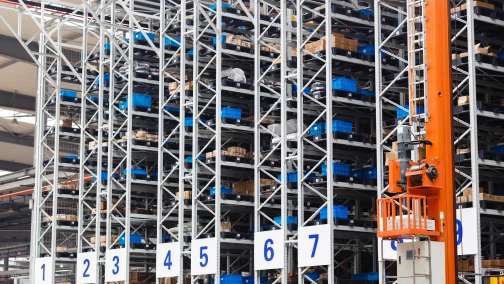
A four-way shuttle is an automated vehicle that runs on rails inside the rack and moves forward, backward, left, and right. A standard two-way shuttle only travels along one axis and stays on its level. The four-way version switches between the running and cross rails, so it changes aisles on its own. Add vertical lifts and the shuttle reaches any level, which turns the whole block of racking into one three-dimensional storage area.

How Multidirectional Movement Works

Each shuttle has two drive systems — one for the X axis, one for the Y axis — and a mechanism that switches between main and cross rails. To travel along an aisle it uses the main rail; to change aisles it lifts onto the cross rail and drives sideways. Vertical movement is handled by lifts at the end of the grid that carry the shuttle, or the tote, between levels. The control system plans each path, routes around busy lanes, and positions to ±1mm before the forks extend.

Why Super-Capacitor Power Changes the Math

Power is where many shuttle and AMR systems lose time. Battery shuttles stop to recharge or swap packs; AMRs queue at charging bays. These shuttles use super-capacitor power that charges in about 10 seconds at the transfer point. The shuttle tops up during the brief stop it already makes to hand off a tote, so it keeps working through the shift. There are no battery bays to build, no swap stations to staff, and no capacity lost as batteries age. In cold storage, where battery performance drops, the advantage grows.

Four-Way Shuttle vs Multi-Level Shuttle vs Stacker Crane

All three store totes densely, but they trade off throughput, redundancy, and cost differently.

SystemMovementThroughputRedundancyBest Fit
Four-way shuttleRoams grid (X/Y) + lifts for levelsHigh, scales with fleetHigh — interchangeable unitsFlexible layouts, peaks, multi-level
Multi-level shuttleOne shuttle fixed per levelVery high per levelPer-level onlyMax throughput, uniform totes
Stacker crane (mini load)One crane per aisle, vertical mastTied to one machineLow — one crane per aisleMixed SKUs, lower entry cost


Throughput and Scalability

A crane couples throughput to one machine per aisle. A shuttle fleet decouples it: add shuttles to the same grid and throughput climbs, up to 3-4 times a single-crane ASRS for the same footprint. Because every shuttle can reach every location, the system sends an idle unit to the next task and balances load across the fleet. You size the fleet to today's order volume and add units later, without rebuilding racking or aisles.

Two-Way, Four-Way, and Variable-Distance Versions

Three configurations cover different needs:

  • Two-way shuttle — travels one axis on a level, simplest and lowest cost, best for single-aisle or single-level layouts.
  • Four-way shuttle — roams the full grid and changes aisles, best for flexible layouts and higher throughput.
  • Variable-distance shuttle — adjusts to different tote pitches and depths, useful for mixed container sizes.

How to Tell If a Shuttle System Fits

A four-way shuttle system is worth modeling when several of these are true:

  • Order volume swings with peaks and you need throughput that scales
  • You want high-density storage but cannot lose time to charging
  • The building has multiple floors or a mezzanine to use
  • Downtime on one machine would stall a whole aisle today
  • Tote and carton sizes vary across your SKUs
  • Cold or chilled storage rules out standard battery handling

For the densest storage of small parts in a low building, a high-density storage layout may suit better; for pallet-scale loads, a heavy-duty system handles the weight totes can't.

Integration with Lifts, Conveyors, and WCS

The fleet runs under a WCS that coordinates every shuttle, lift, and conveyor in real time, with a WMS or ERP link over standard Ethernet for orders and inventory. Lifts move shuttles or totes between levels and must be sized to peak flow so they do not become a bottleneck. Conveyor or goods-to-person stations at the grid edge match the shuttle's transfer height and speed. With the interfaces validated early, the fleet, lifts, and stations work as one system from inbound to dispatch.